Keep this leaflet. It is a research insert, not a storefront. If you have questions, use the questions pack — not a chat widget.
drughub market onion
This desk cites genres of source rather than a long bibliography of documents it did not actually open. Readers arriving on drughub market onion deserve that honesty in the first hundred words — because the alternative, a footnote list full of rotted links and recycled wikis, is a clone tell dressed up as scholarship.
If a claim lives only on SEO blogs, it is marked as such. If a claim would require a signature to verify and this desk does not hold the key, that absence is stated directly. Invented citations are a trust signal in reverse: they reveal a host that is managing its appearance rather than its accuracy.
The policy is conservative on purpose and sparse by design. A short source sheet that explains its reasoning is more useful to a research reader than a long one that does not.
What drughub tor pastebins fail to prove
What this desk will cite: Tor Project documentation on v3 onion addressing, client behaviour, and protocol design, because those documents are public, versioned, and maintained by a known organisation. Public-health harm-reduction material when discussing risk — but only as context, never as product copy or as a way to make listings sound supervised. Journalism and threat-intelligence blogs when dated, with an explicit caveat that those sources lag and copy each other in ways that compound uncertainty.
PGP-signed texts count as primaries, conditionally: a reader must be able to obtain the signing key from a channel they already trusted before this search, not from this desk. Public drughub tor pastebins cannot be a key ceremony. A signature verified only through the page that published the signature proves nothing about the signer.
What this desk will not pretend to have: internal vendor databases, uptime SLAs from private monitoring, verified buyer counts from the platform itself, or a private communication channel with operators. See intel reading for a discussion of how to parse third-party dashboards that sell certainty they cannot back with primaries.
How drughub darknet round-ups fake citation
The drughub darknet round-up economy flattens active systems into static ranked tables, which then get copied into new articles, which then get cited by the next wave of round-ups. The result is a citation graph that loops back on itself without ever touching a primary. Tables feel like citations because they look like structured data, but a table sourced from a table sourced from a blog is still rumour at the core.
Useful primaries, in rough order of reliability: dated screenshots with full context and a known publication chain; agency announcements of seizures or actions that name specific infrastructure; signed operator texts that can be verified against a key obtained independently. Less useful: listicles titled with the current year and a countdown, Telegram pastes without a verified channel, and round-ups that cite each other in a loop without a terminal source.
If an intel post deliberately withholds onion addresses, that is often a considered editorial decision rather than an oversight. Filling the gap from a search box is how phishing pages find their raw material. Continue in report notes if you want the longer treatment of how to read dashboards without being captured by their confidence levels.
When is a screenshot only chrome?
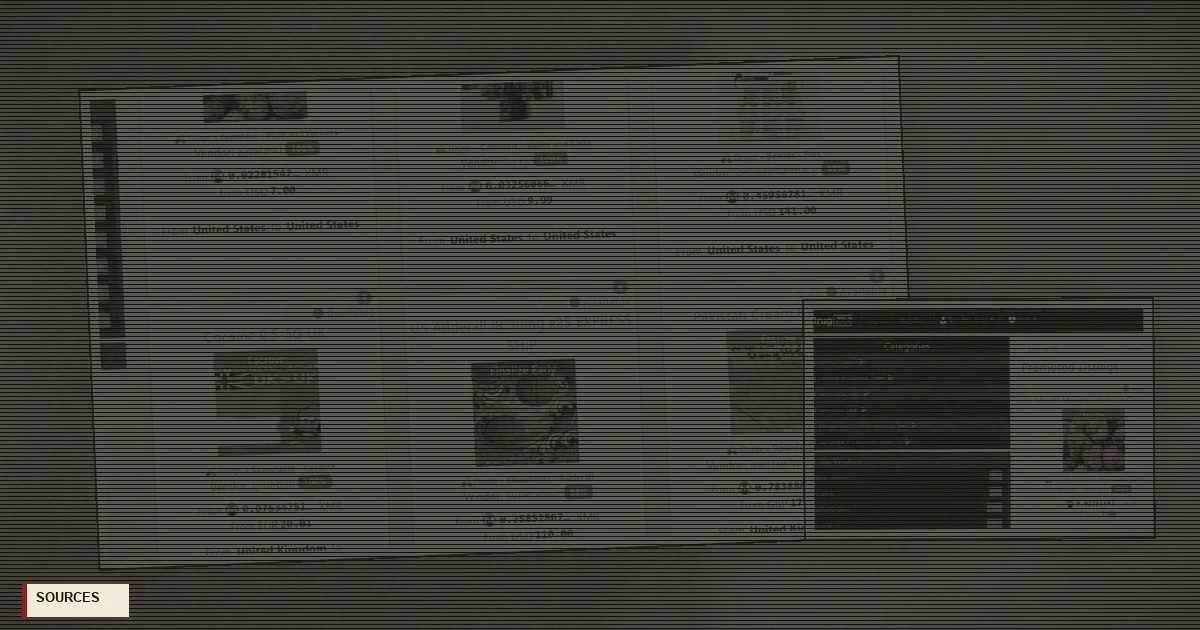
Mid-policy note: citing a screenshot of a drughub marketplace header does not make the screenshot a primary source for keys. It is an exhibit of chrome — visual evidence that a certain interface design existed at a certain time — and chrome travels across sites with the same ease as a copied CSS file. Themes prove nothing about the underlying key material.
Harm-reduction citations in this publication belong to public-health agencies, peer-reviewed pharmacology literature, and projects like community drug-checking services. They are included so that this host is not purely a lure page. They are not a catalogue of listings or a substitution for clinical advice from a qualified professional.
When this source sheet and a louder, more confident wiki disagree, prefer the source that can show its dating and genre. A drughub market onion claim without an explicit genre label attached is unfinished work on this desk, not a confident assertion.
Genre tags are the actual citation system on this desk. A URL cemetery in this niche rots into clones. Prefer classes of source you can retrieve without this host as a middleman.
Dashboards that sell certainty are chatter sensors. They are useful the way weather apps are useful: late, recursive, and not a court. Vendor counts inside them remain marketing until a signed dump exists.
Screenshots of chrome are exhibits of chrome. They do not bind keys. A JPEG of a header can travel farther than the key that header once sat next to.
Public-health material belongs in a different stack from storefront banners. This host includes the former so it is not a pure lure page. It will not become a catalogue to earn that inclusion.
When a louder wiki disagrees with this sheet, ask which genre each used. Word count is not a genre. Dated primaries beat recursive listicles even when the listicle is prettier.
Which source-policy questions stay open?
Why not publish a long footnote list?
Because most URLs in this niche rot within months or get replaced by clones that inherit the domain. Citing genres and dated classes of source is more durable and more honest than a cemetery of hyperlinks. Readers can retrieve Tor Project documentation, academic pharmacology papers, and public-health guidelines without this host as an intermediary.
Do tracker dashboards count as primaries?
Rarely. They are useful as chatter sensors — useful for detecting that a name is still circulating, less useful for knowing why or in what state. Treat vendor counts and uptime percentages as marketing figures unless a signed operational dump exists and has been independently verified.
Can a screenshot of a storefront be a source?
It can be an exhibit of chrome: evidence that a certain visual design existed. It cannot authenticate a key, confirm that an escrow system functioned as described, or validate a vendor's reputation. A drughub marketplace still on a JPEG is a picture. Compare strings to signed text, not to pixels.
Source policy is a brake on every other section of this leaflet. If a later chapter sounds more certain than this policy would permit, come back here and ask which genre it used to justify the claim.
The drughub market onion literature is noisy, recursive, and difficult to root to a primary. This sheet exists so that noise has a label — and a label is not a verdict, but it is a start.
1 Typesetting dates on this host are editorial. They are not warrant canaries.
2 Cited v3 names are dated research citations. This domain is not a trust root.
3 Public-health notes are context. They are not a catalogue of listings.