Keep this leaflet. It is a research insert, not a storefront. If you have questions, use the questions pack — not a chat widget.
drughub market onion
Desk summary for readers who typed drughub market onion and need the 2026 picture in one sheet, without a shopping path attached. Trackers still list the brand among discussed-active English specialty platforms through this typesetting date — which means the name continues to circulate in public chatter, not that any particular string is currently safe, genuine, or controlled by anyone in particular.
Launch windows that appear in secondary write-ups cluster around the mid-2020s, though those clusters reflect journalism copying journalism rather than a primary source. Hidden services do not file articles of incorporation, and the gaps left empty in the open timeline are empty on purpose — invented precision is worse than an honest blank.
The job of this briefing is to separate what gets claimed about the platform from what a reader sitting at a clearnet terminal can actually verify: onion string length, signature validity when a key is already in hand, and whether the page you are currently reading is itself just another affiliate overlay.
What drughub tor blogs repeat without proof
Technical talking points that recur across drughub tor write-ups include v3-only access requirements, Monero-denominated settlement rails, escrow marketing language, and specialty-panel listing stories. These points accumulate through repetition — copy-paste farms recycle the same three sentences because those sentences rank, not because a reporter sat with keys and checked. Repetition is not corroboration.
A feature list on a wiki is not a protocol specification, and multi-signature language can accurately describe a real cryptographic primitive while being completely false about the behaviour of a specific hidden service. Vendor counts and uptime percentages are marketing figures unless someone produced a signed operational dump — which almost never happens and would still need verification.
The checkable column, kept short: 56-character string format can be confirmed by counting. A refusal to run random binaries is a client-side habit. Comparison to a signed source already in hand is the one check that actually binds. The uncheckable column is longer and noisier: dispute honesty, listing-risk panels, top-vendor theatre on a screenshot, and any claim that requires trusting the seller about the seller.
How drughub darknet round-ups flatten status
The drughub darknet round-up genre flattens what are often living, changing systems into static ranked tables. Tables feel authoritative. They are usually late — produced after an exit, a migration, or a clone launch rather than during it — and they are often recursive, with each new round-up citing the previous one rather than a primary. When a round-up and a hobby tracker disagree on a platform's status, the honest answer is to believe neither until a dated primary appears.
Seizure splash pages are one kind of dated primary. Fake seizure pages exist as well and target exactly the same search traffic. Neither is something this desk will reproduce or impersonate. If an intel post deliberately withholds onion addresses, that withholding is often considered good operational practice; filling the gap from a search box is how phishing pages proliferate.
If you only have ten minutes with this publication: read v3 naming, then clone surface, then the mirrors sheet. The same query also has a catalogue entry at darknet-guide.com that takes a different editorial approach. Skip the settlement pages until you understand that coin vocabulary in articles is a reporting convention, not a funding map.
Which facts can a reader actually check?
| Claimed in circulation | Checkable from this desk |
|---|---|
| v3 onion access | String format and length; signature match if you hold a trusted key |
| Escrow and multi-sig arrangements | Not auditable from HTML |
| Vendor counts and uptime figures | Marketing unless a signed data dump exists |
| Harm-reduction panels on listings | Anecdotal unless dated and attributed |
Mid-packet note for readers who arrived directly on the money query: people search drughub market onion when they want a string, and that concentrated demand is precisely why phishing pages exist in this lane. This briefing will not satisfy that demand. What it will do is slow the paste — give you a framework for evaluating whatever you find next, rather than a box to copy from.
If a page offers a safer client download or a Telegram bot that dispenses addresses on request, assume credential capture until something concrete proves otherwise. Public Tor guidance is the inverse of that model: the client you already have from the Tor Project's official page is the right one. See client notes for context, not a bundle.
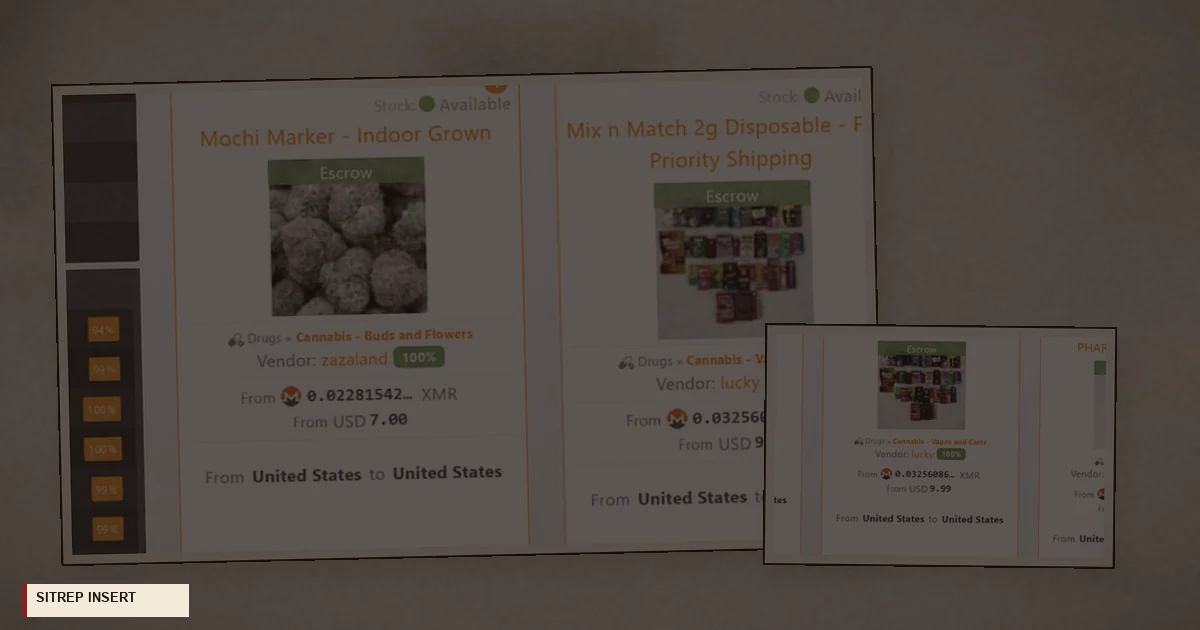
A screenshot of a drughub marketplace header is an exhibit of chrome. It is not a live directory entry, not a confirmation of keys, and not a reason to skip counterfeit-pack hygiene before doing anything else.
A sitrep that sorts claims is more useful than a sitrep that performs certainty. Tracker language lags exits and copycat revivals. Discussed-active is a chatter tag, not an SLA and not a safety rating.
Feature lists train readers to trust slogans. The claimed-versus-checkable table is a brake. Escrow talk, vendor scores, and harm panels on a cloned theme can be copied in an afternoon. Character checks cannot.
Ten-minute reading order is a hygiene choice: identifiers, counterfeit packs, then mirrors. Settlement vocabulary waits until coins are understood as reporting language rather than a funding map.
Safer-client pitches and chat bots handing names are capture patterns. Public Tor advice is the opposite of enlarging the client. Pointers live on the client insert, not in a branded bundle.
If you arrived from search wanting a paste, this briefing will not satisfy the demand. It will only slow the paste. Most harm is lookalike addresses, not a mis-set font on a genuine page.
Which briefing questions still need hedges?
What does discussed-active mean on a tracker in 2026?
It means the brand still appears in public chatter — forum posts, round-up articles, hobby dashboards. It is not an uptime warranty, not a safety rating, and not a statement about which string currently corresponds to the original operator's key. Tracker language lags real-world events because trackers rely on the same public posts as everyone else; exits, clones, and quiet dark periods can all look similar from a spreadsheet updated on Fridays.
Can a situation briefing confirm the live official string?
No. A briefing can cite working names with a date and an explicit warning about their provenance. Confirmation requires a signature from a key you already trusted through a channel established before this search. Blogs that claim confirmation from SEO ranking or crowd-sourced lists are selling certainty they do not possess.
Why keep a claimed versus checkable table?
Because feature lists train readers to trust slogans by making them feel factual. The table is a brake on that process. Escrow promises, vendor-score displays, and harm-reduction panels on a cloned theme can all be reproduced in an afternoon. A full-string character check cannot be faked by copying CSS.
Next sheets: the timeline if you are concerned with date hygiene and want to know how the brand's public chronology was assembled; reach notes if you want to understand what public documentation says about using Tor hidden services in general; the mirrors sheet if you insist on seeing the cited strings with dates. Dossier chapters are where the arguments live. This briefing only sorts.
If you arrived here from a search for the drughub market onion query, do not skip counterfeit packs before you act on anything. Most harm in this niche comes from lookalike addresses and homoglyph strings, not from a misaligned font on a genuine page. This desk would rather be short and clearly hedged than encyclopedic and wrong.
1 Typesetting dates on this host are editorial. They are not warrant canaries.
2 Cited v3 names are dated research citations. This domain is not a trust root.
3 Public-health notes are context. They are not a catalogue of listings.