Keep this leaflet. It is a research insert, not a storefront. If you have questions, use the questions pack — not a chat widget.
drughub market onion
drughubmarket-onion.com is a static research publication. Readers who searched drughub market onion should know that on the first screen: this host is not operated by a market, does not process payments, does not run a hidden service, and does not function as an affiliate. The voice is a package insert on purpose — dry, precise, and explicit about what it cannot verify — because a familiar cream theme on a .com proves exactly nothing about keys.
The publication's editorial posture is conservative by design. Where public sources disagree, this desk notes the disagreement rather than picking a winner. Where a claim requires a signature this desk does not hold, it says so. Where an exact date cannot be traced to a primary, the cell stays empty. A short honest table beats a fake 40-event chronology every time, even if the short table looks less authoritative.
Corrections are handled the same way: if a dated public source demonstrates that something published here is wrong, the next revision pages the briefing and the identifier block with an amendment note. Hiding corrections behind a redesign is a clone tell.
How drughub tor blogs impersonate operator desks
This host is built for one query and nothing else — it does not 301 onto a louder wiki, does not aggregate traffic from sister sites, and does not expand its scope to look encyclopedic. A catalogue companion for the same query is maintained at darknet-guide.com/drughub-market-onion/, which takes a different editorial approach. Money URLs stay one per query per host; that discipline is also an architecture choice.
Public drughub tor blogs frequently present themselves as operator desks — using first-person plural voice, suggesting insider knowledge, and implying that their citations have been vetted by someone with key access. This colophon does the opposite: it names the gap explicitly. If you ever see register, fund, vendor-bond, or join-now language on any page of this publication, treat the page as compromised rather than updated.
Publication identifier: PL 26-02 Rev. 01, typeset 1 Sep 2026. Timestamps are editorial records, not warrant canaries. See insert 04 if that distinction is not immediately clear, because the confusion between the two is a real source of misinformation in this niche.
What drughub darknet certainty this colophon refuses
The drughub darknet SEO economy rewards certainty — sites that commit to definitive vendor counts, uptime guarantees, and live-string claims attract more clicks than sites that hedge — and this desk sells none of that. Scope is deliberately narrow: v3 identifier hygiene, public-source chronology, harm-reduction context drawn from public-health literature, and a steady explanation of why clones work as well as they do.
Citation policy is stated in full at sources. The short version: Tor Project documentation, dated journalism with explicit caveats, and PGP-signed texts when a reader can independently obtain the key. This host cannot bootstrap trust from a fresh .com alone, which means it also cannot bootstrap it for you.
Operational claims this desk will never make: internal vendor databases, uptime SLAs derived from private monitoring, verified buyer counts, or anything requiring insider access to the hidden service. Those numbers on clone sites are decoration. The absence of those numbers here is a feature, not an oversight.
Which limits should a reader pin to this host?
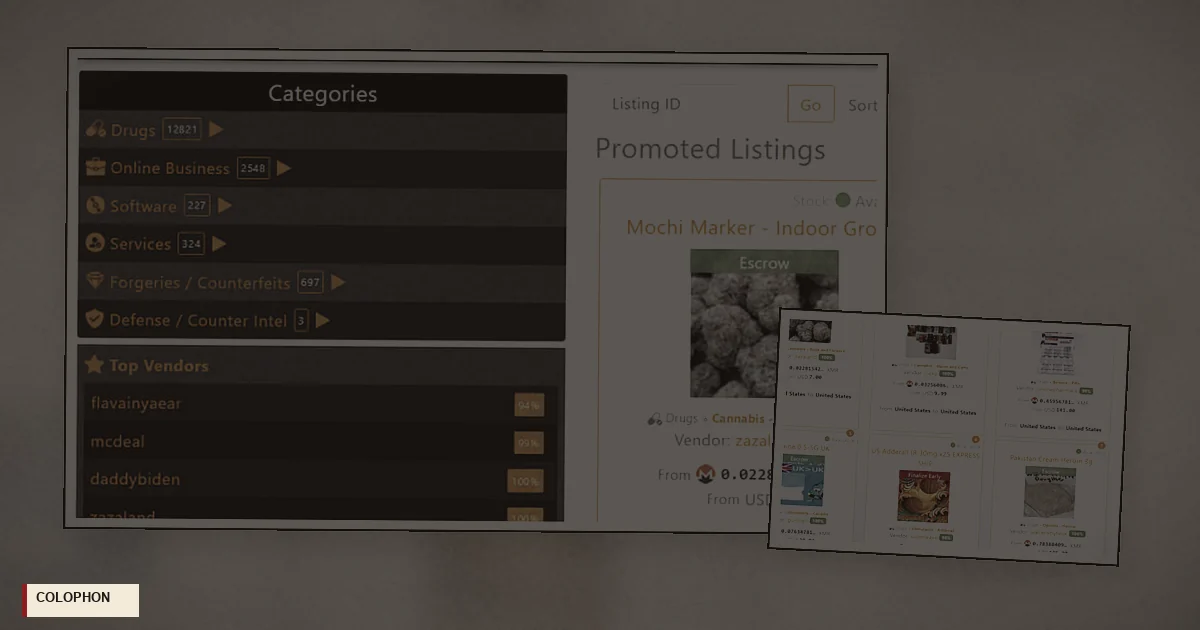
Mid-colophon reminder: a cream leaflet theme does not authenticate a drughub market onion string, and neither does a wordmark on a screenshot. The exhibit in the image library on the home page is a still of a documented interface — chrome, not a passport, and not a tool for accessing anything.
A cloned drughub marketplace layout can be rebuilt over a weekend with publicly available CSS and a copied article. Keys cannot be copied in the same way, which is precisely why the visual layer of a hidden service and its cryptographic identity are completely independent. That independence is the whole problem this publication exists to acknowledge.
Package inserts, dossier chapters, and question pages are separate indexed documents. They do not simply repeat this colophon with synonyms attached to make the word count. Use inserts for dated memos that are meant to be replaced when facts change; use dossier chapters for arguments that are meant to be revised when the argument improves.
A colophon is a brake. It exists so later chapters cannot quietly become a storefront. If conversion verbs appear on this host, treat the page as compromised rather than as a new feature.
Two research hosts on related queries are a deliberate split, not a failed merge. Different chrome reduces the chance that a reader treats both as one operator desk. In-content links are cross-checks.
Typesetting stamps will keep looking like canaries to tired readers. They are not. A canary needs a key you already trusted and a cadence you can check. A running header cannot borrow that costume.
This desk does not run a hidden service, process payments, or staff a support queue. Those sentences belong here so they can be quoted when a louder page claims otherwise.
If you needed an operator's word, you are in the wrong genre and this colophon says so without a countdown timer. Dull limits are the product.
Which about-page questions still get asked?
Who operates this package leaflet?
An independent research desk, not a marketplace. There is no support queue, no escrow function, no vendor onboarding, and no payment processing. This host is not an operator canary, not an affiliate, and not a front for anything other than a static HTML publication.
Is this leaflet an official operator site?
No. It is an independent research overlay competing in the same search lane as the brand it studies. It does not claim operator status, does not impersonate official communications, and does not merge into a louder wiki to borrow authority.
Is the typesetting date a warrant canary?
No. Footer dates, sitemap lastmod values, and publication identifiers are editorial records showing when the content was last reviewed. A canary is a specific instrument: a signed negative statement issued on a known cadence from a key you already trusted through a pre-established channel. Do not confuse a drughub marketplace rumour with that instrument.
If you needed a storefront, you are on the wrong genre of page. If you needed a signed onion confirmed by someone with key access, you are also on the wrong genre — and this colophon says so plainly rather than letting you discover it after reading twelve pages.
Continue reading only if you want hygiene notes, date context, and a framework for evaluating what you find elsewhere. The drughub market onion query will keep producing louder, more confident-sounding hosts. This one would rather be dull and explicit about its limits than polished and misleading about its authority.
1 Typesetting dates on this host are editorial. They are not warrant canaries.
2 Cited v3 names are dated research citations. This domain is not a trust root.
3 Public-health notes are context. They are not a catalogue of listings.